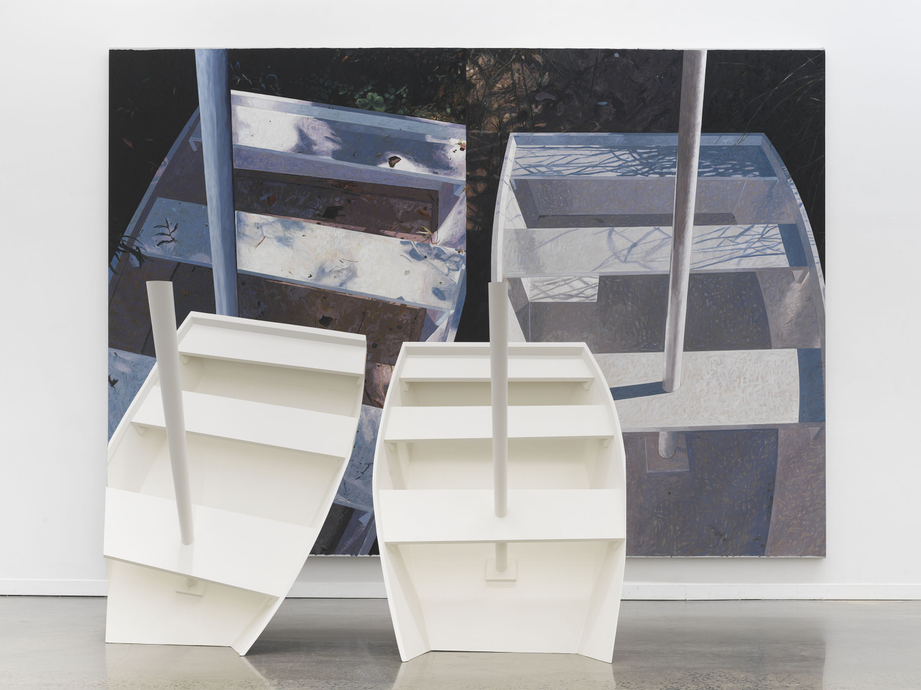
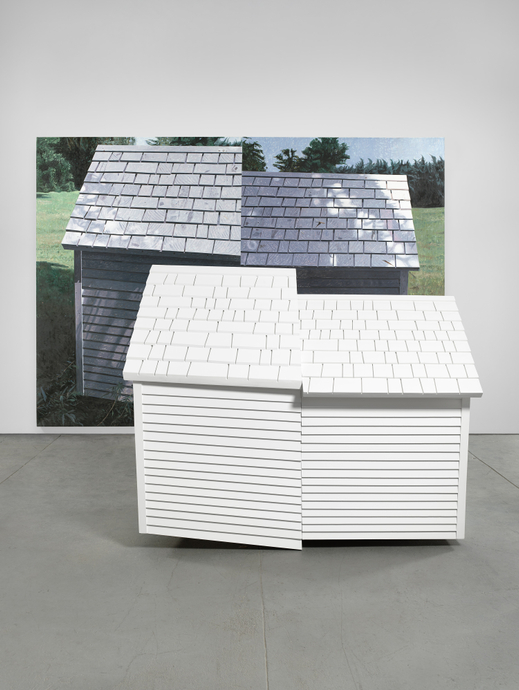
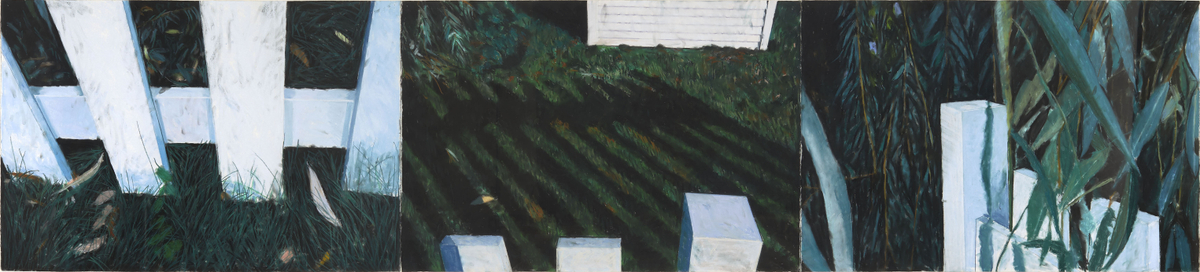
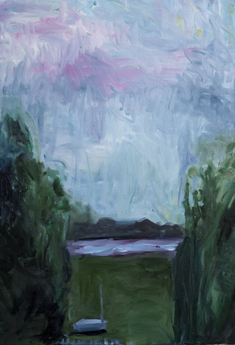
Locks Gallery is pleased to present American Classic, an exhibition of historical works by Jennifer Bartlett (1941-2022) created between 1985-1987. Central to the exhibition are two monumental paintings with sculptural objects, alongside two rarely shown series titled At Sands Point and Old House Lane, all featuring houses, boats, and white-picket fences, quintessential symbols of Americana. Highlighting Bartlett’s iterative and multi-part approach to painting, American Classic traces the artist’s turn to cinematic figurative art and the literary influences that underscored her creative process.
Starting in the 1970s, when Bartlett developed her landmark steel-plate installations, such as Rhapsody (1975-76), she envisioned the viewer “reading” the paintings from left to right, invoking the directionality of an embodied narrative. In the 1980s, she continued to explore ideas of seriality developed in her conceptual plate paintings, while shifting her focus to more traditional painting on canvas with figurative motifs and landscapes. Her epic In the Garden series from 1980 marks this definitive shift in her work. Moving to Nice, France, for six months, she exhaustively rendered hundreds of viewpoints of the backyard of the villa where she was staying, using numerous materials and styles (oil, charcoal, pastel, gouache, enamel on glass). The ominously painted trees, overgrown garden, and pool with a fountain-statue of a boy, reflect the artist’s psyche at the time—like a prisoner in an abandoned old-world estate, she presents In the Garden as a cheeky nod and stark contrast to ideas of the French Riviera encountered on the pages of F. Scott Fitzgerald’s seductive roman-à-clef Tender is the Night.
In 1984, Bartlett created a large-scale commission at the Volvo headquarters in Gothenburg, Sweden, where she began to explore the use of three-dimensional objects placed in front of her paintings, extracting imagery from the canvas directly into physical space. Her massive installation Sea Wall from 1985 is a prime example of this period. Presenting idiosyncratic archetypes that appear benign and fantastical on the canvas, their three-dimensional facsimiles appear strange and obstructive, challenging the viewer to experience painted space in an entirely new way.
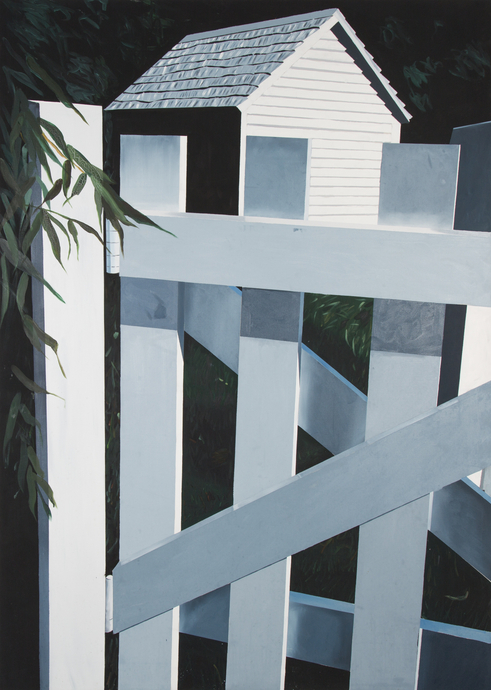
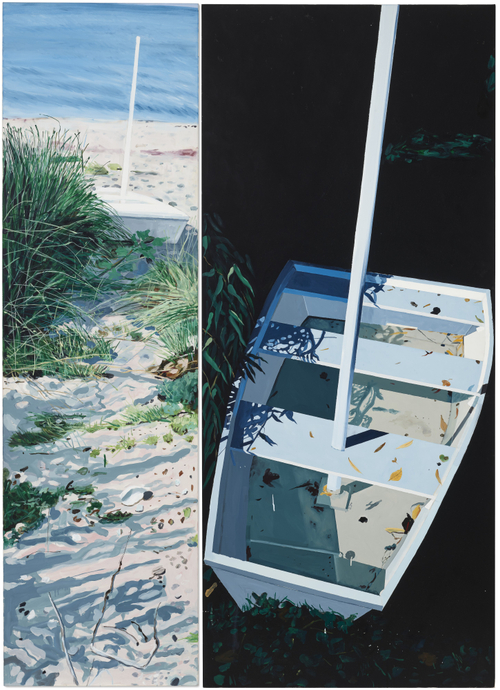
Returning to the United States, Bartlett’s work intertwines with Fitzgerald once again, in the setting of her subsequent series, At Sands Point (1985-86) and Old House Lane (1986-87), which are ostensibly based on the Long Island locale of the fictional town East Egg from The Great Gatsby. Against the opulent lifestyle of Gatsby, Bartlett produces her own “American classic” through multiple paintings in various styles and vantages. With repeating motifs of a white clapboard house, a white dinghy, and a white picket fence, each suggesting elements of a narrative recombined and re-presented anew, she draws upon a range of cinematic and literary traditions—such as Akira Kurosawa’s Rashomon or Lawrence Durrell’s The Alexandria Quartet, whose frameworks underscore an epistemological approach to human perception and memory. She says, “The Quartet contains different points of view of the same sequence of events, much like my painting, where each panel is a self-contained story.”
Recalling literary critic Mikhail Bakhtin’s conception of “polyphony”, Bartlett’s paintings from this period read like a narrative told from multiple simultaneous viewpoints, ultimately arriving at a dialogic truth. Not only does she shift perspectives with a kind of cinematic lens, she seamlessly experiments with a range of painting styles, from abstracted, gestural brushstrokes to a kind of pastoral impressionism and beguiling hyperrealism. Bartlett directs us from distant views, such as in At Sands Point #37 (1986) where the recurring white house lingers as a blurred reminiscence under a weeping willow, to close-ups like At Sands Point #49 (1986), where she illuminates the fine details of the house’s shingling and shadowed panels. In Old House Lane #19 (1986), Bartlett presents a pastel triptych of shifting angles of a fence—the sequence rendered like a storyboard for a film. (Another triptych from the same series, Old House Lane #22 (1986), was chosen as the poster for the 1989 New York Film Festival.)
Around this time, Bartlett was working on her own roman-à-clef, History of the Universe, published in 1985. Centering on a female artist born in Long Beach, California, who studied at Yale and worked in New York City, Bartlett reconfigures her life and surroundings into a complex and disorienting view of the world. In the novel’s first part, titled “Family,” she fittingly begins with two images of a boathouse, echoing the dual subjects around which this exhibition is based, as seen in Boats (1987) and Double House (1987).
The effect of these chosen icons becomes even more complicated as she extracts them from the canvas and renders them as mirrored sculptures, reflecting both themselves as hybrid objects and the painted image from which they originate. The boat, a vessel for travel, is made obsolete as Bartlett crops the hull and allows it to be subsumed by the floor, permanently capsizing. The house, a place of security, is at odds with itself, bisected and disjointed. In another image, the door of the house is slightly ajar, revealing not the interior but a view of the outside as if the structure is merely a prop with no contents inside. Within each of these pared-down motifs, Bartlett presents a state of being: the transitory boat, the settled house, and the enclosing or imposing fence. The virtuosic ease with which she paints each scene offers the viewer easy entrance into her universe, but the strange, fragmented presence and distorted points of view create a dialectic between the familiar and the uncanny, and between physical and perspectival space. Though the works are absent of any human beings, the constantly shifting circumstances suggest agency, or the presence of an event, with the viewer entering the scene after the action has taken place. It is in these remnants that Bartlett simultaneously construes and obscures a sense of narrative, drawing upon the anodyne American homescape as an unsettling backdrop.
Jennifer Bartlett (née Losch; 1941–2022) was born in Long Beach, CA, studied at Mills College in California, and graduated from Yale University before moving to New York City in 1967. Within her prolific painting practice, she consistently explored the environments she inhabited and, through multiple iterations of the same image or theme, exhausted their possibilities for representation.
Bartlett’s first retrospective was held in 1985 at the Walker Art Center, MN, and traveled to the Nelson-Atkins Museum of Art, Kansas City, MO; the Brooklyn Museum, NY; and the Carnegie Museum of Art, Pittsburgh, PA. In 2006, the Addison Gallery of American Art presented a survey of Bartlett’s early enameled steel plate paintings in the period from 1968–76. In 2013–14, Klaus Ottmann curated her second traveling survey, Jennifer Bartlett: History of the Universe: Works 1970–2011, at the Pennsylvania Academy of the Fine Arts, Philadelphia, PA, and the Parrish Art Museum, Water Mills, NY. In 2014, the Cleveland Museum of Art united her three monumental plate pieces, Rhapsody (1975-76), Song (2007), and Recitative (2009-10) in the exhibition Epic Systems.
The artist’s works are represented in the collections of the Dallas Museum of Fine Arts, TX; Los Angeles County Museum of Art, CA; The Metropolitan Museum of Art, NY; Museum of Fine Arts, Houston, TX; Museum of Modern Art, NY; Philadelphia Museum of Art, Philadelphia, PA; San Francisco Museum of Modern Art, CA; Tate Modern, London, UK; and the Whitney Museum of American Art, New York, NY, among many others.
Locks Gallery has represented the artist for over 30 years.